
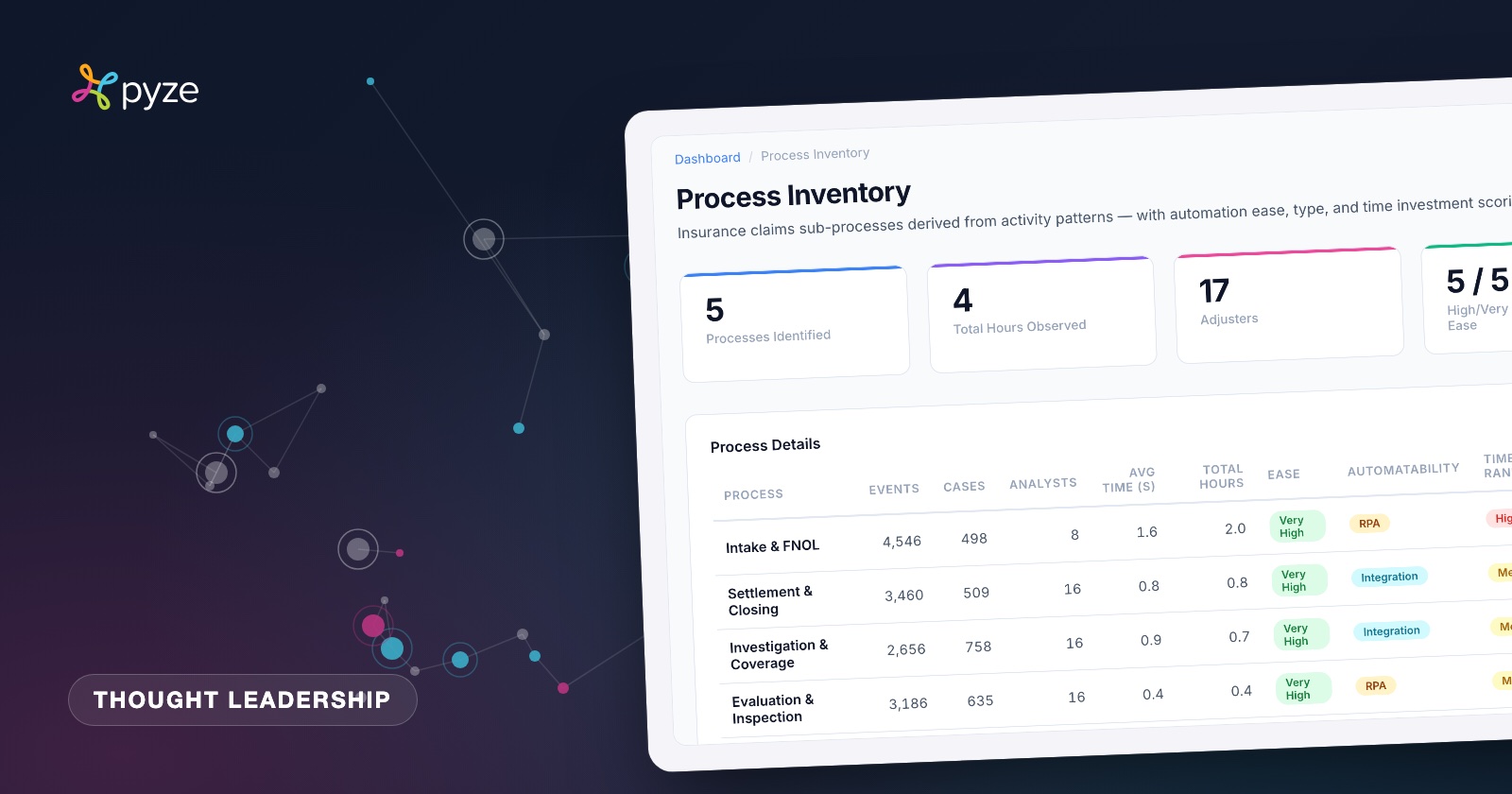
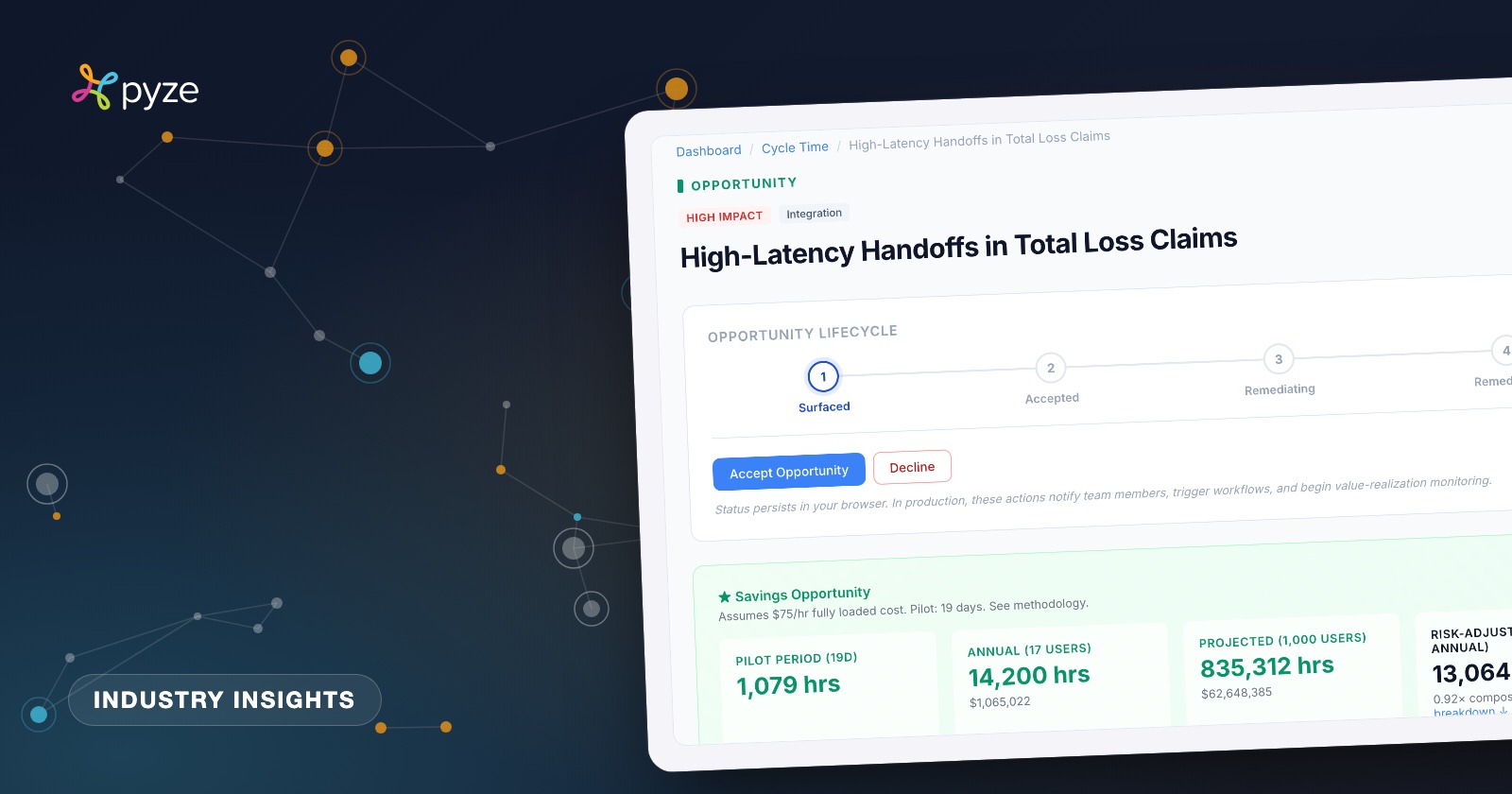
Measure How Underwriting Time Is Spent Before and After Submission Triage Changes
Pyze measures how underwriters and underwriting support staff move through submissions, data enrichment, referrals and policy issuance, so the share of time spent on non-underwriting work is counted.
Structural facts about the method, not engagement outcomes or guarantees. What a given underwriting operation yields depends on its product mix and how much of the work sits inside the policy system.
Underwriting leaders are asked to grow capacity and improve broker turnaround without lowering risk selection standards. Submission volumes, quote times and hit ratios are reported, but the time underwriters spend on intake, data entry, enrichment and referral handling is not recorded in any of those figures. Without that measure, requests for additional capacity and for automation are difficult to prioritize.
Questions Asked of This Role
Underwriter time spent on submission intake, data entry and document handling instead of risk assessment
Triage rules that route submissions inconsistently, with no measure of the effort each route consumes
Broker turnaround that varies by team and product with no explanation in the policy system
Referral and authority handling that adds steps and elapsed time to a share of submissions
Data enrichment from multiple external sources performed by hand in separate applications
Key Questions and Outcomes
Each question shows the answer available today, why that answer is insufficient, and what changes with Pyze.
How much underwriter time is spent on work that is not underwriting?
Underwriter interviews and a time allocation survey.
Self-reported allocation varies by respondent and does not separate intake, enrichment, referral and decision effort within a single submission. It cannot be repeated after a change to confirm the result.
Measured time and application sequence per submission type for underwriters and support staff, separating intake, enrichment, referral and decision work.
Why is broker turnaround longer for some submissions and teams?
Quote turnaround by line of business from the policy administration system.
Turnaround shows elapsed time, not the sequence of steps behind it. Waiting for information, rekeying data and referral loops are not distinguished.
The observed path through each submission type, including steps outside the policy system, so elapsed time resolves into work, rework and waiting.
Which data enrichment and referral steps should be automated first?
A backlog ranked by the opinion of underwriting leads and the technology team.
Perceived effort favors work that is memorable over work that is frequent. The ranking has no cost basis and no precondition check, so a candidate can be funded without knowing what it requires.
Candidates derived from observed execution and the underwriting guidelines, ranked by measured effort, with the inputs, rules and referral conditions each one requires.
Engagement Sequence
Instrument underwriters and support staff across the policy system, rating tools, external data sources, email and document tools in scope. Ingest underwriting guidelines for the conformance view.
Effort sized by submission type and workflow step. Triage, enrichment and referral opportunities sorted across the five levers, each with its preconditions.
First changes land in the highest-ranked workflows. Measurement continues, so the change in underwriter time and turnaround is measured.
Frequently Asked Questions
Does Pyze change underwriting decisions or authority limits? +
No. Pyze measures how work is performed and where effort goes. Risk selection, pricing and authority remain with underwriting. Where a candidate for automation touches a referral or authority rule, the blueprint states the rule and its source so the control stays explicit.
Is risk or applicant data collected? +
No. Pyze captures application interaction metadata only: which application, which screen, the sequence and the timing. It does not capture keystrokes, field values, free text or screen contents. Collection is limited to a whitelist of business applications, and identifiers are pseudonymous.
Can we use it to prepare for a submission triage or intake automation? +
Yes. The baseline shows how much effort intake and triage consume today by submission type, which is the figure a triage or intake investment should be priced against, and the same measurement is used afterwards to check the result.