
Establish a Measured Baseline for Service Levels, Pricing and Location Strategy
Pyze measures how work is performed across sites and processes in a shared services organization, so conversations with business units rest on observed effort, variation and capacity.
Structural facts about the method, not engagement outcomes or guarantees. What a given shared services organization yields depends on its process mix and how much of the work sits inside a system of record.
Shared services and global business services leaders negotiate service levels and prices with business units, run the same process in several locations and manage a backlog of automation requests. The data for those conversations is usually volumes, headcount and system-reported cycle time. How much effort each transaction type requires, how that differs between sites and where automation would remove it are rarely known, so each negotiation starts from assumptions.
Questions Asked of This Role
Service-level and pricing conversations with business units that rely on volumes and headcount instead of measured effort per transaction
The same process performed differently across sites, with no measure of the variation or its cost
An automation backlog ranked by requester priority or perceived effort
Transitions and rebalancing across locations planned without a baseline of the work being moved
Continuous improvement teams that cannot show the effect of a change on the work performed
Key Questions and Outcomes
Each question shows the answer available today, why that answer is insufficient, and what changes with Pyze.
What does it take to deliver this service, and is the price justified?
A cost model built from headcount, volumes and time studies.
Time studies sample a few people over a short period and are contested by the business unit. Volume-based unit costs assume every transaction takes the same effort.
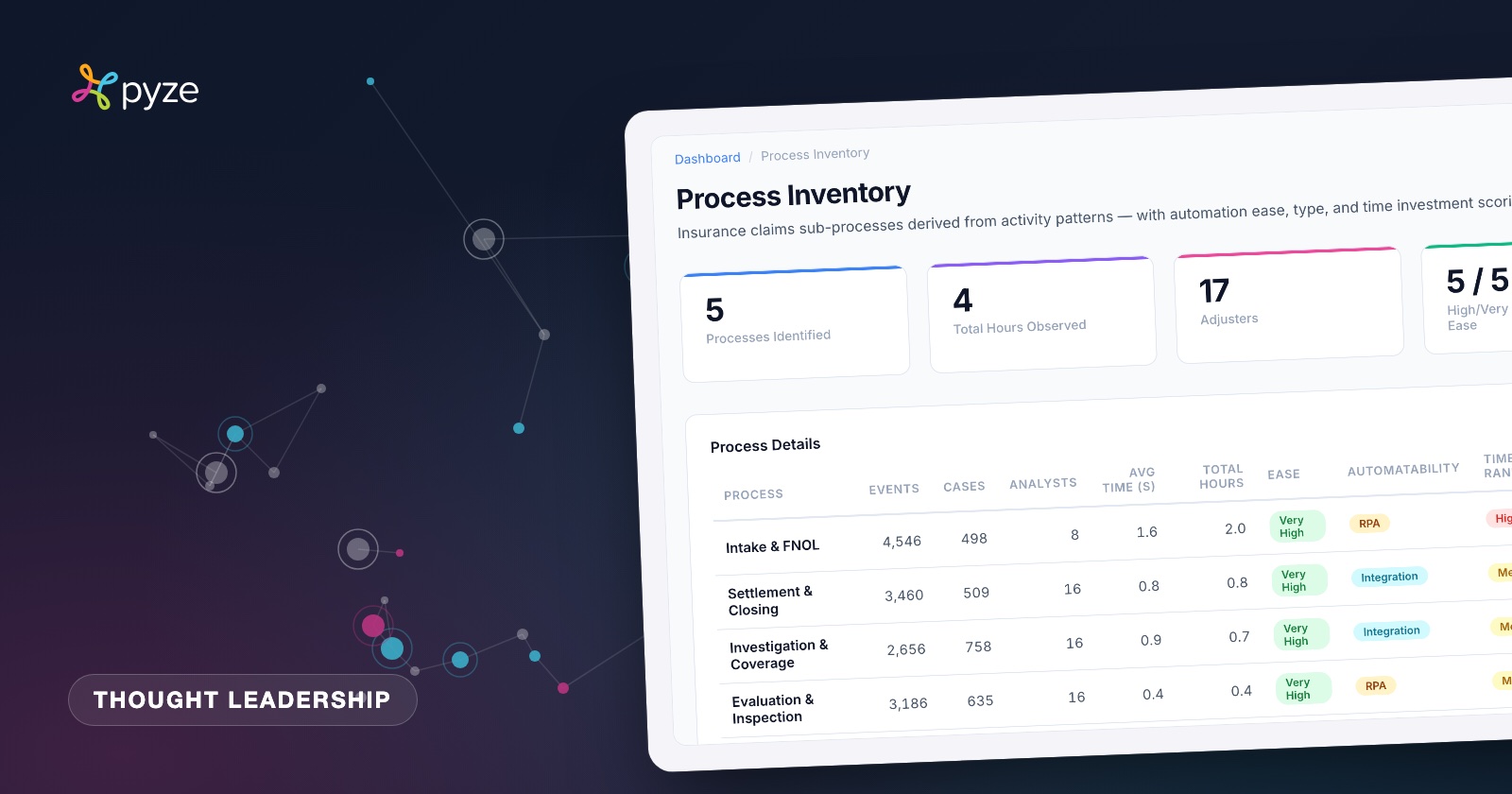
Measured effort per transaction type and workflow across the full population of staff in scope, which gives service-level and pricing discussions an observed basis that both parties can inspect.
Why does the same process perform differently across our sites?
Site-level productivity and cycle time comparisons from workflow tools.
The metrics show that sites differ, not which steps, applications or practices explain it. Differences in case mix, local workarounds and procedure drift are not separated.
The observed path each site takes through the same process, so variation resolves into specific steps and the standardize and rebalance levers can be sized.
Which automation requests should be built first, and which should not be built?
A backlog ranked by sponsor priority and estimated effort.
Estimated effort is not measured, so the ranking cannot be defended to sponsors whose requests are deferred. The cost to build is not compared with the value at the same volume.
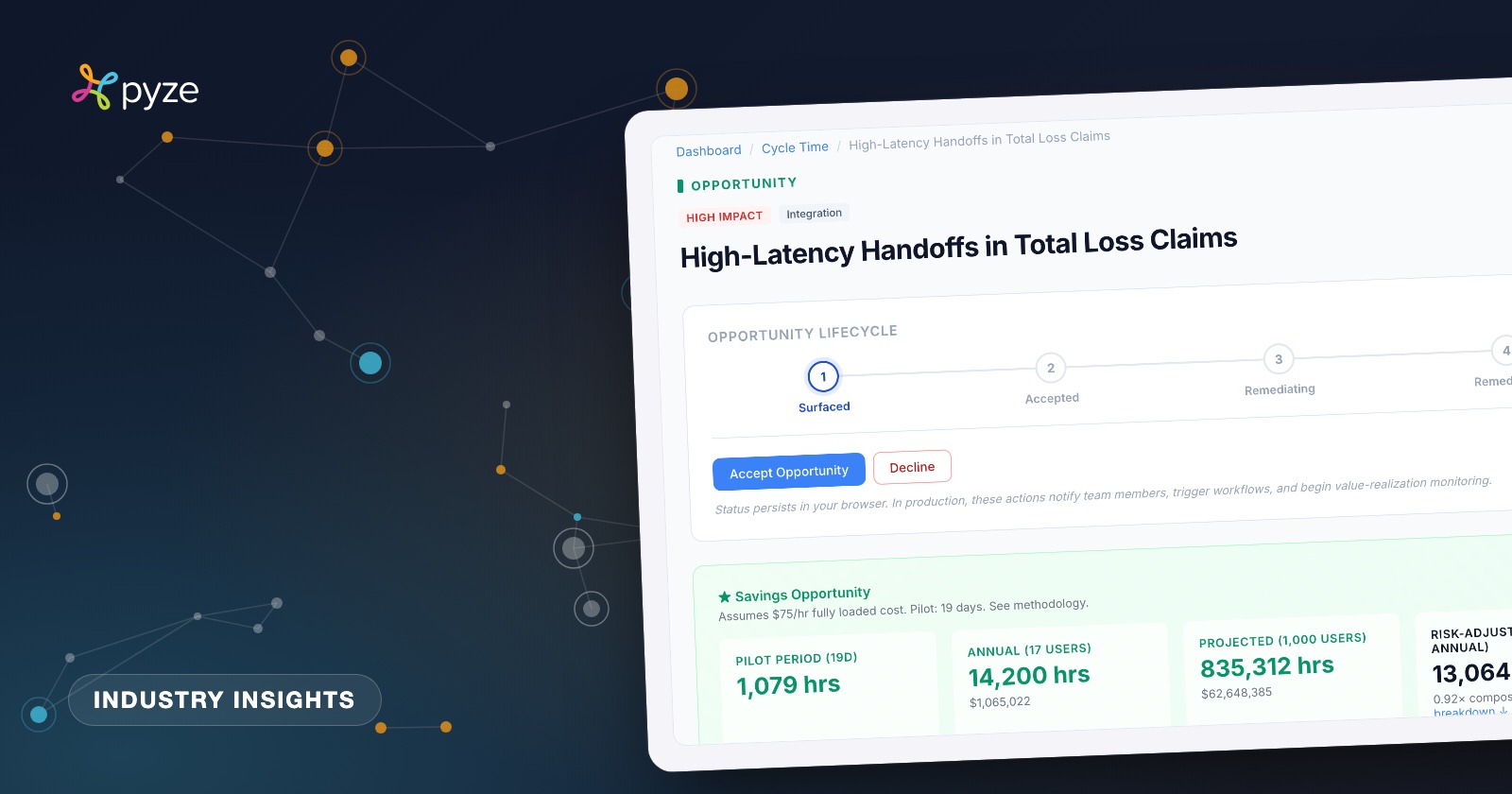
Each candidate carries measured effort, build cost, run cost and payback at the same population, with the preconditions that are outstanding, so the order of work and the requests that do not qualify are both documented.
Engagement Sequence
Instrument the processes and sites in scope across the scoped applications. Ingest the procedure documents. Work continues normally during measurement.
Effort per transaction type sized by site, variation identified, and the automation backlog re-ranked and priced across the five levers.
First changes land and the baseline is shared with business units. Measurement continues so the effect of each change is measured against the same basis.
Frequently Asked Questions
Can the baseline be shared with business units? +
Yes. The baseline is reported at the process level, with the method visible, so it can be reviewed with business unit stakeholders. It does not include data on individuals, and the scope of what is shown can be agreed in advance.
Is this employee monitoring? +
No. Pyze captures application interaction metadata only: which application, which screen, the sequence and the timing. It does not capture keystrokes, field values, free text or screen contents. Collection is limited to a whitelist of business applications, identifiers are pseudonymous, and the unit of analysis is the process.
How does it support a transition or a move of work between locations? +
The baseline documents how the work is performed today, including steps outside the system of record, which is the information a transition plan needs. The same measurement after the move shows whether the work was performed the same way at the receiving site.