
Measure the Return on AI Investment
Pyze separates capacity released by a change from capacity moved elsewhere, so approved business cases can be audited afterwards.
The first two figures are third-party research from MIT and McKinsey, attributed and linked on the evidence page. They describe the market, not Pyze engagements.
Published research on enterprise AI returns shows that most programmes cannot demonstrate a P&L effect. The cause is rarely the technology: the work was not measured before it changed, so there is no baseline against which to claim anything. A CFO approving the next tranche is asked to fund a number that cannot be verified.
Questions Asked of This Role
A growing AI budget with no defensible link to a line in the P&L
Savings claims that assume released hours convert to cost, which they usually do not
Business cases where the value and the cost are stated at different scales
Pressure to show a return on last year before approving this year
Key Questions and Outcomes
Each question shows the answer available today, why that answer is insufficient, and what changes with Pyze.
What did we get for last year of AI spend?
Licence counts, adoption rates and a deck of pilot results.
Adoption does not measure impact. A tool can be used daily without changing how long the work takes or how many people it needs.
Hours measured before and after, split into what an agent absorbed, what it assisted, and what stayed with a person. Only absorbed hours count as a capacity claim.
Is this saving real or is it moving?
A business case that sums every improvement into one number.
Released and redistributed capacity are different things, and summing them double-counts. Effort pushed from one team to another reads as a saving in the first team’s case.
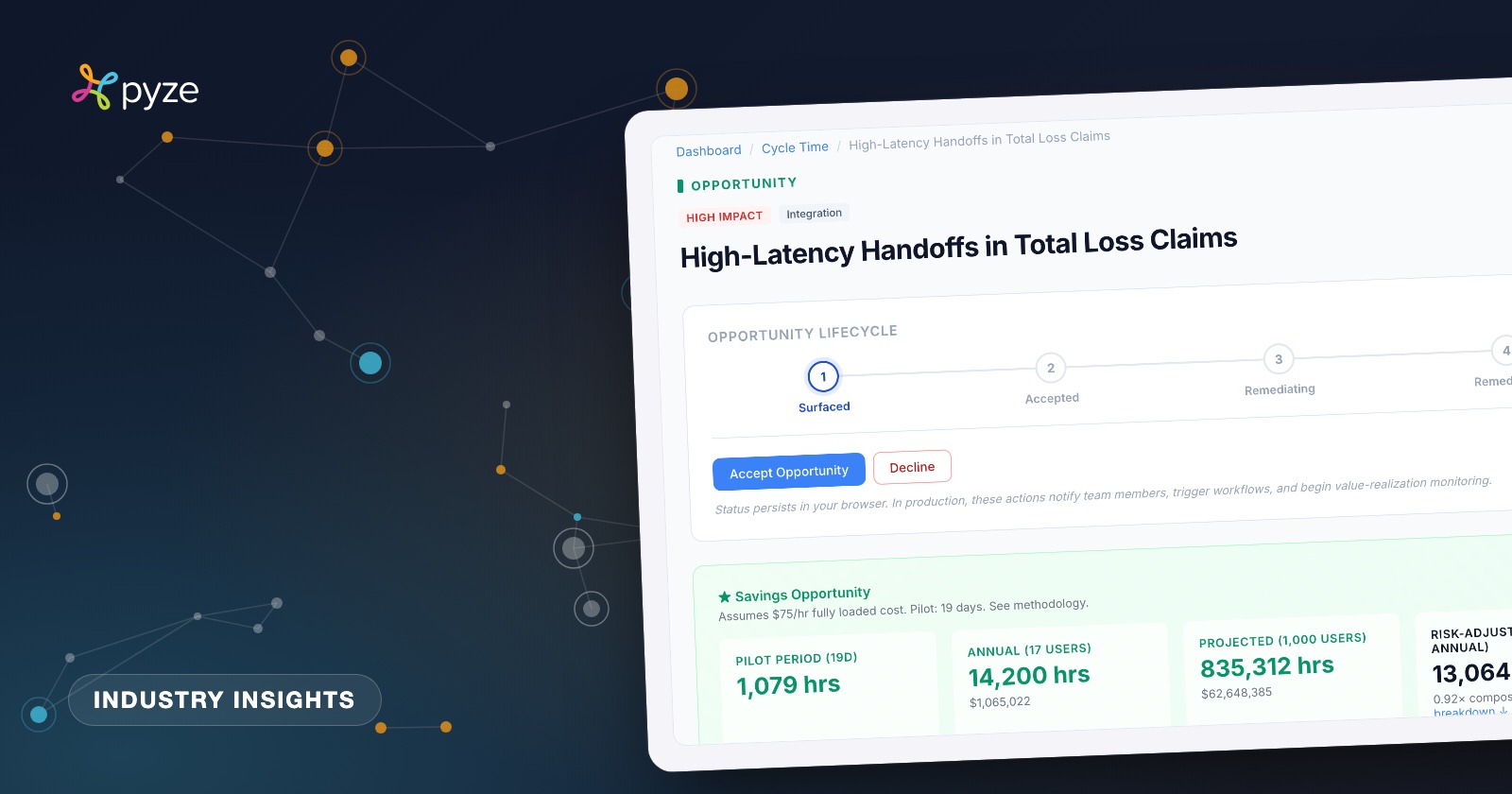
Released and redistributed capacity are reported separately and never summed, so the released figure is credible.
Why did handling time go up after we deployed the agent?
An assumption that the deployment failed.
When an agent absorbs the straightforward work, the cases left for people are the harder ones, so average handling time rises. Read without that context, the agent appears to have hurt performance, and the programme may be cut for the wrong reason.
The absorbed, assisted and retained split makes the mix shift explicit, so a rising average has a documented explanation.
Engagement Sequence
A measured baseline on one process, at a cost that does not require a business case of its own.
Each candidate priced with its build cost, run cost and payback stated at the same population, so the ratio is comparable.
The same measurement is applied to the result, so the approved claim can be audited.
Frequently Asked Questions
Does released capacity mean headcount reduction? +
Not on its own. Released capacity is hours that no longer have to be spent. Whether that becomes cost reduction, absorbed volume growth or avoided hiring is a management decision, and Pyze reports the hours without assuming which one you will take. Conflating the two reduces the credibility of business cases.
How quickly does a baseline pay for itself? +
The baseline is scoped to be small enough that it does not need its own business case, and it typically identifies capacity worth many multiples of its cost. The more useful test is whether it stops one bad build, which it frequently does.
Can we measure a programme already underway? +
Yes, though with a caveat. Without a pre-change baseline the before side is reconstructed rather than measured, and we will label it that way. The comparison is still useful, but weaker than one where measurement was running first.