
Four-Stage Methodology
Pyze analyzes your SOPs, applications and user activity, identifies where AI agents apply, and measures the results after deployment.
Measured Return
Other platforms quantify the return you can expect.
Pyze measures the return realized.
A business case is a forecast built before anything changes, and it is rarely reviewed afterward. The fourth stage closes that gap, and the engagement continues after the readout.
Four Stages
The fourth stage feeds back into the first, so the methodology operates as an ongoing capability.
Baseline
The measured cost of the work today.
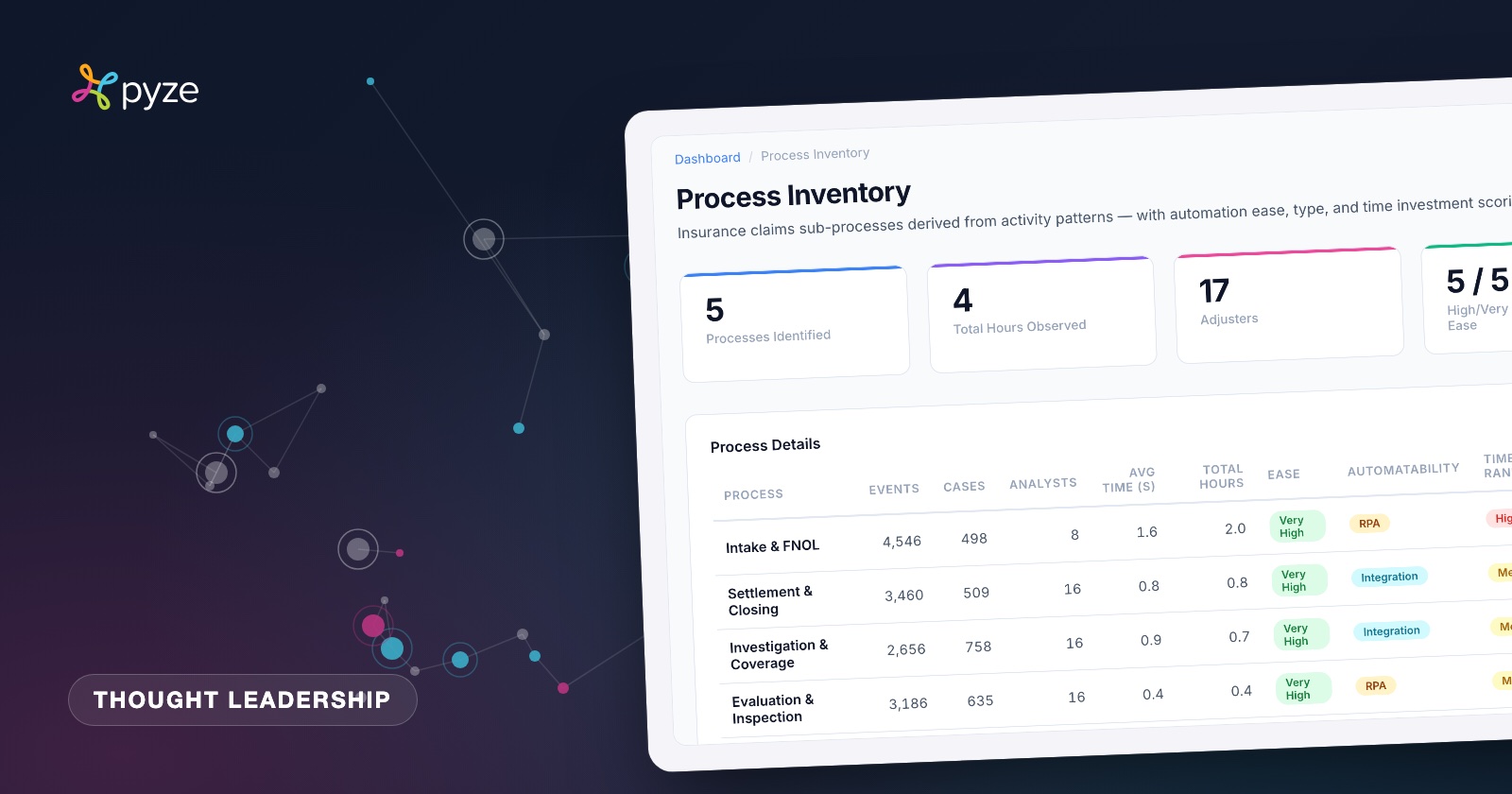
Pyze instruments every person and every application continuously, inside the system of record and outside it. No sampling, time-and-motion studies or workshops are required. The result is a cost and effort baseline for the work as it is performed, which is the reference for every later measurement.
- Every user, every application, continuously
- Inside the system of record and outside it
- Pseudonymous by design, with no PII and no content capture
- A measured baseline, captured before anything changes
Blueprint
SOPs, applications and user activity combined into one target state.
Procedure documents parse into a structured task tree. Application configuration yields the business rules the platform already enforces. Execution evidence shows what happens in practice. Where the three sources disagree defines the transformation agenda, and the disagreement can be measured.
- Procedures ingested at estate scale, not sampled
- Business rules extracted from configuration rather than reconstructed in workshops
- One master standard plus the differences per desk
- Gaps identified where no rule exists
Transform
Where agents, automation and standardisation apply, each opportunity priced and assigned an owner.
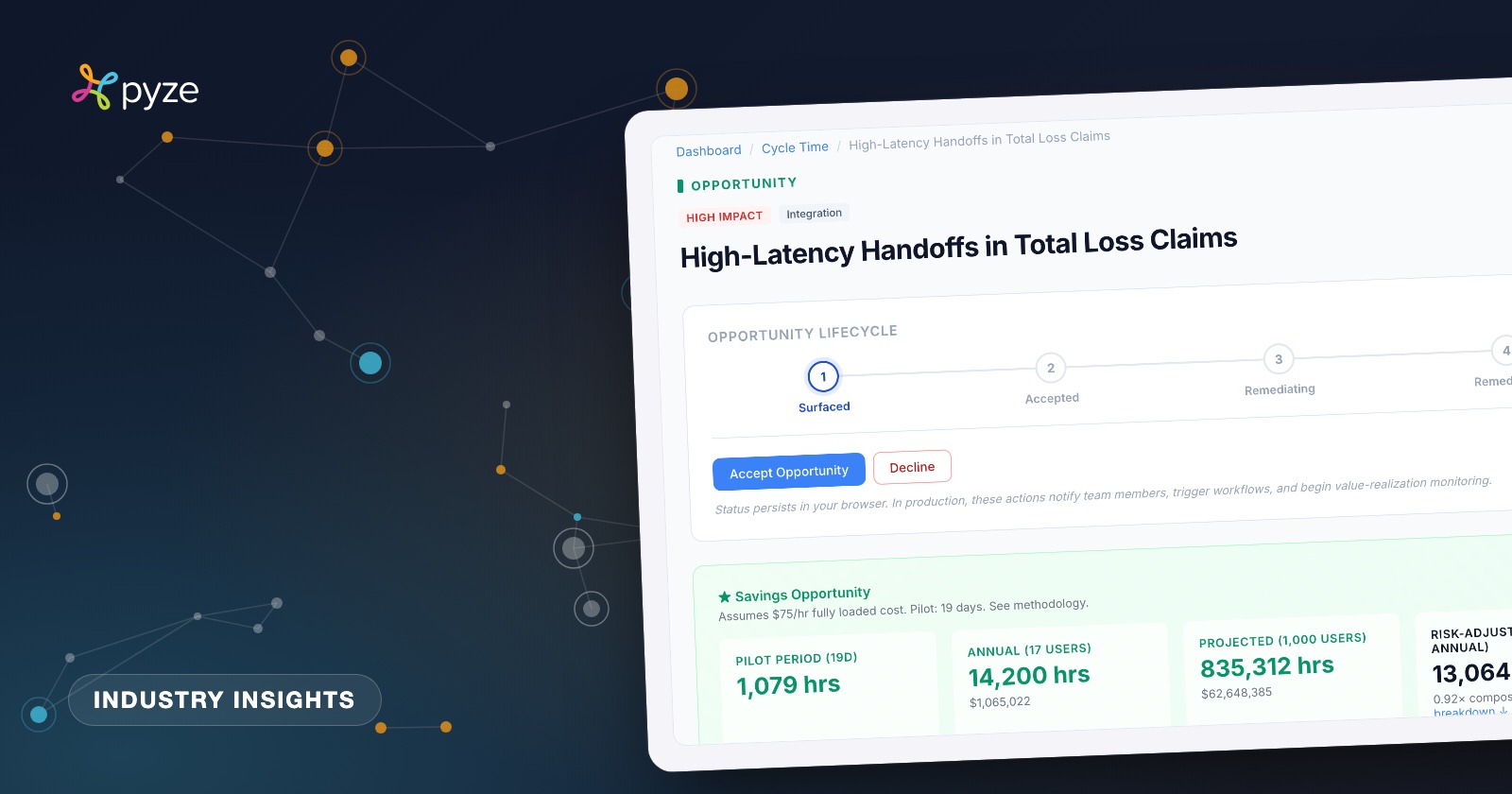
Every opportunity carries the evidence it came from, an owner who can act on it, an expected recovery rate, and the question that would disprove it. Opportunities that cannot be evidenced are listed as open questions and excluded from the total.
- Standardize, Simplify, Rebalance, Automate, Agentify
- Each opportunity priced in hours and traced to case-level evidence
- Recoverable capacity stated as a range rather than the full pool
- Named owner for every item
Prove
Post-change results measured against the baseline using the same method.
Once agents and people share a queue, absorbed, assisted and retained work become indistinguishable in the case record. Pyze separates them and re-scores the estate on the same measures each quarter, so every claimed change is supported by measurement.
- Absorbed, assisted and retained, measured per person and per work type
- Accept, override and ignore, recorded per person rather than per team
- A noise floor established first, so alerts are meaningful
- The same cells re-scored each quarter against the original baseline
Each cycle costs less than the last, because measurement is already in place and the standard is already documented.
Five Value Levers
Most findings in a transformation programme are not automation problems. Classifying each finding by the lever that resolves it produces a work plan rather than a list of deviations.
Standardize
One procedure where there were many. The foundation the other four levers depend on.
Simplify
Steps the procedure requires that produce no outcome, removed rather than accelerated.
Rebalance
Work spread evenly across a team that is already carrying it unevenly. No technology required.
Automate
Deterministic work with a stated rule, scheduled, batched or integrated away.
Agentify
Decisions rather than mechanics. Apply the rule, diagnose the exception, negotiate the outcome, draft the reply.
Automate applies to deterministic work. Agentify applies to decisions. Scheduling a report is a different problem from diagnosing an exception, and a programme that treats them the same will over-scope the first and miss the second.
Measurement Standards
The methodology applies the following constraints so that reported figures withstand review by a steering committee.
Present modelled figures as measured figures
A baseline is observed. A projection is calculated from stated assumptions. Every figure is labelled as one or the other, and the assumptions are named constants that a client can review and adjust.
Add released capacity to redistributed attention
Automating a report releases hours. Reducing the time someone spends watching a queue converts attention, and attention does not appear in a headcount plan. Both are reported. They are never summed.
Claim the full pool as recoverable
Every remedy leaves exception handling, oversight and the cases the rule does not cover. Recovery is stated as a band with the capture rate on the page.
Invent a cause to explain a finding
Where the measurement flags a problem but no cause has been isolated, the report says so. A cause asserted without evidence does not withstand review.
Full Engagement Example
Order management at a Fortune 500 global CPG
Delivered with a global systems integrator. Six weeks from instrumentation to a priced opportunity register, and a measured capacity release inside the first month.
Start With the Baseline
Measurement is installed first, before design decisions are final. A baseline reconstructed afterward is an estimate.