
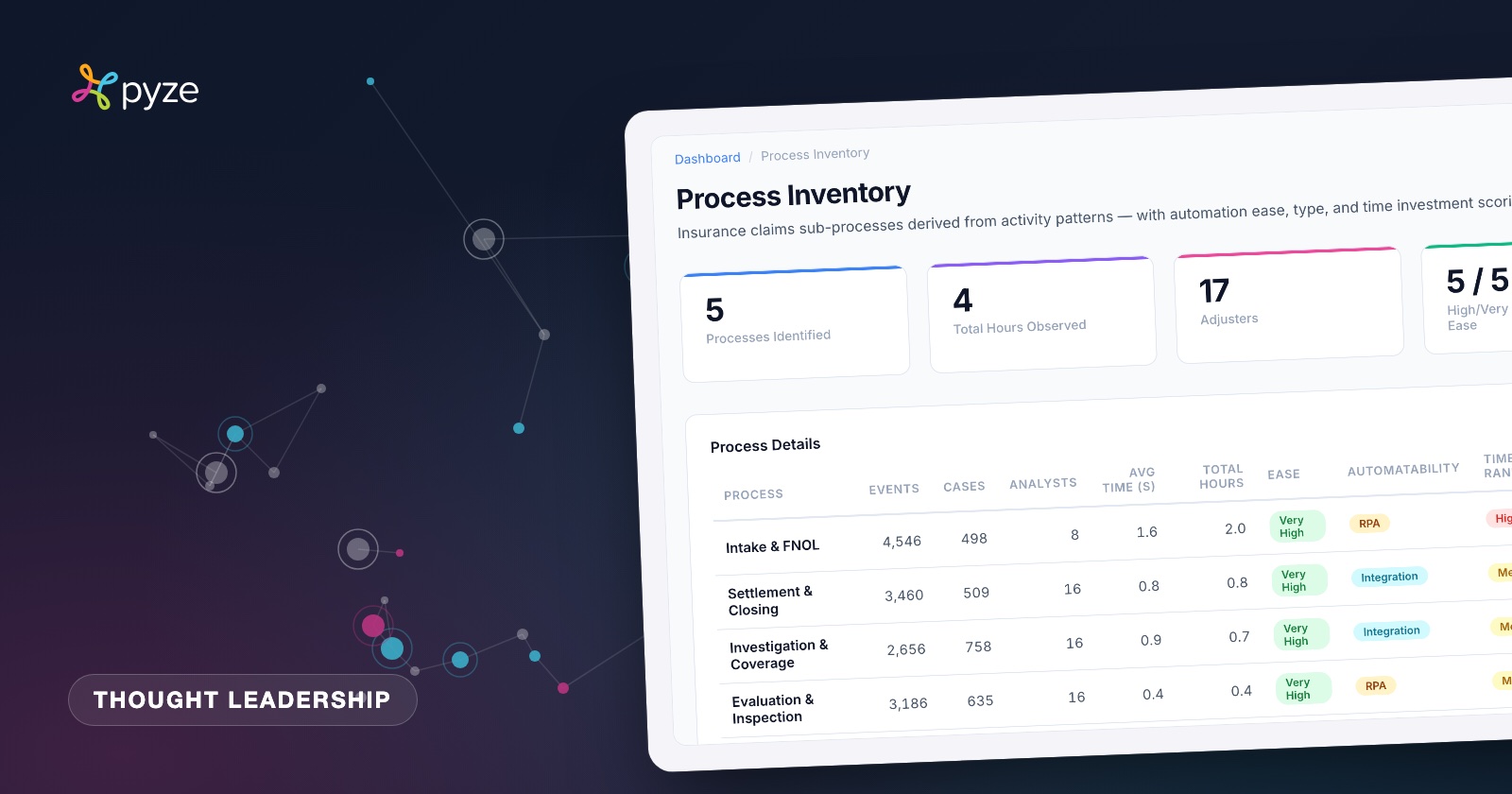
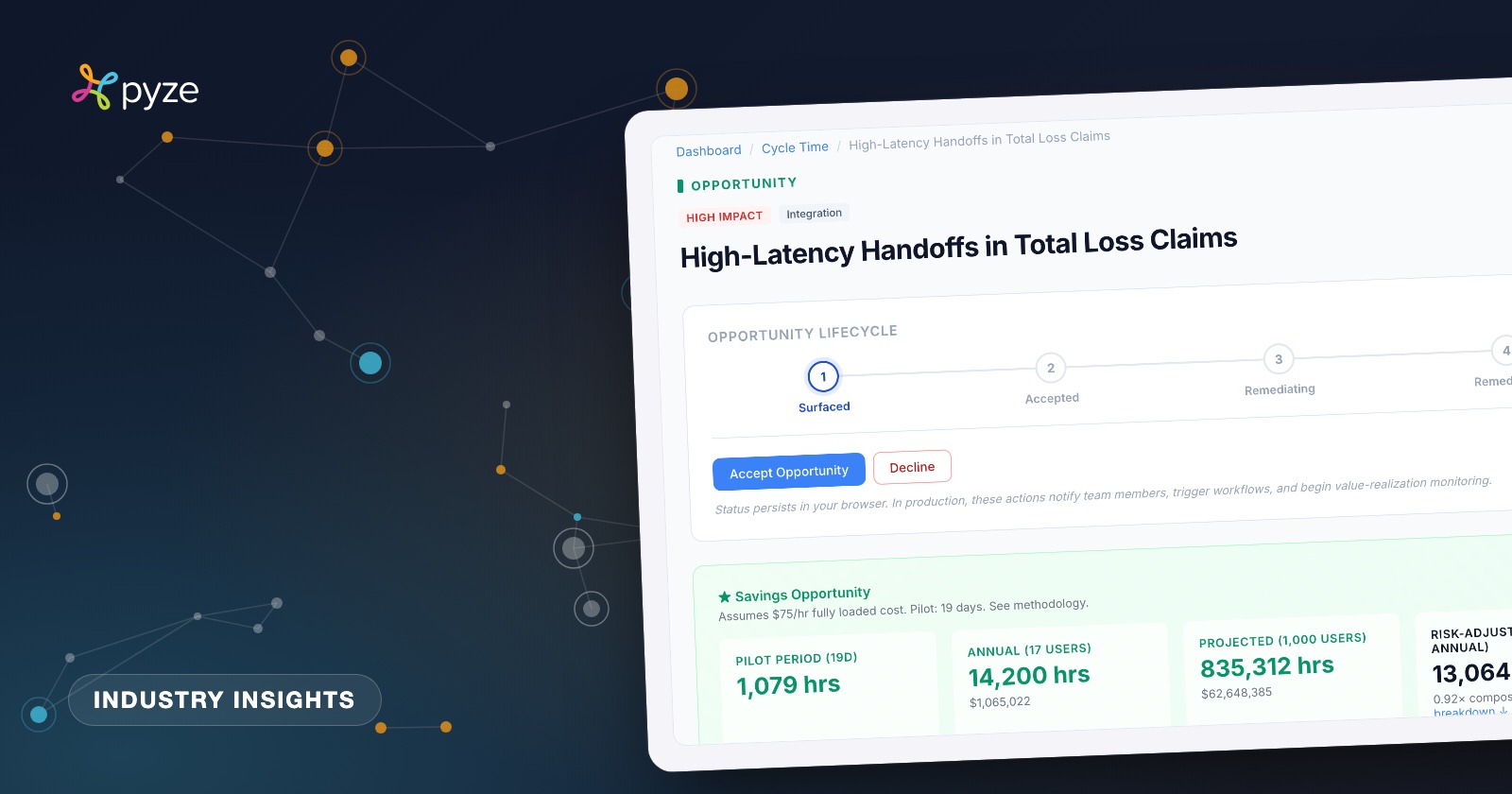
Measuring how delivery hours are spent
Pyze measures delivery work across the applications used to perform it, so utilisation, standardisation and AI agent opportunities are based on measured evidence instead of timesheets.
Engagement archetypes from Pyze deployments across managed services and business process operations rather than a single named account.
Professional services firms and business process outsourcers price and manage on time, and the only record of that time is typically a timesheet completed from memory at the end of the week. The industry depends on knowing where effort goes and has limited measurement of it.
Common Findings in Professional & Business Services
Four patterns that recur across engagements, each shown with the measurement and the resulting change.
Margin on this account changed, and the activity responsible is not known.
SimplifyEffort is measured against the work performed instead of a timesheet completed from memory.
Margin movement is traced to specific activities, so it can be addressed operationally.
A productivity gain was committed in the contract and cannot be evidenced.
StandardizeNo baseline was measured beforehand, so neither the gain nor any counter-claim can be evidenced.
A baseline is established at transition, so the committed gain is measured against it instead of negotiated at renewal.
Delivery quality varies by pod and is managed with additional supervision.
StandardizeVariation reflects technique and not capability, and is visible at the step level against a comparable cohort.
The best pod becomes the documented standard, and conformance is scored continuously instead of sampled.
Clients ask for AI agents to be deployed into delivery, with a priced gainshare.
AgentifyA gainshare requires a measured baseline and a measured result. Most firms can produce neither, so the fee is negotiated instead of calculated.
Released capacity is measured with the same method as the baseline, which makes an outcome-based fee calculable.
Opportunity Register
A sample register, sorted by the lever that resolves each opportunity. In an engagement, each line carries measured hours, a named owner and the evidence it was derived from.
Systems typically instrumented
Capture covers browser-delivered and thick-client applications, including virtualized estates, with no change to how anyone works.
Roles Involved
Instrumentation is configured per application rather than per person, so the population in scope is set during scoping and is not a deployment constraint.
How an Engagement Runs
Baseline, blueprint, transform, prove
The same four stages apply in every sector. The fourth stage repeats the baseline measurement, which makes the engagement an ongoing operating capability rather than a one-time report.
Baseline
What the work costs today, measured across every person and application.
Blueprint
Procedures, application rules and execution evidence, read as one target state.
Transform
Where each of the five levers applies, priced and owned.
Prove
The after state measured against the baseline, using the same method.
Delivered with a global systems integrator
Pyze is deployed alongside systems integrators and BPO providers as the measurement layer under their delivery commitments, including a Fortune 500 global CPG order management engagement where roughly ten percent of desk capacity was realized within thirty days.
Read the walkthroughFrequently Asked Questions
Our clients are sensitive about monitoring. How is that handled?
Can this support an outcome-based or gainshare commercial model?
Functions
Related
Start with a measured baseline
Six weeks from instrumentation to a priced opportunity register, and the baseline stays in place so later quarters are measured rather than re-estimated.