
Continuous Evidence of Control Effectiveness
Pyze measures how contract, compliance and control work is performed, and produces the evidence an auditor asks for as a standing output.
Engagement archetypes from Pyze deployments across compliance and controls operations rather than a single named account.
Legal and compliance functions carry documentation obligations that are expensive to meet and difficult to evidence. Control testing samples a handful of cases a year, which is the available method when the remaining cases are not measured.
Common Findings in Legal & Compliance
Four patterns that recur across engagements, each shown with the measurement and the resulting change.
Controls are tested on a sample that may not be representative.
StandardizeEvery execution is scored against the documented standard, so conformance is a population measure rather than an inference from twenty cases.
Testing effort moves from establishing what happened to investigating what the measurement flagged.
Contract review is a bottleneck with a persistent queue.
AgentifyMost reviews follow a documented playbook and a minority need judgement, and both take the same route.
Playbook review handled with the position drafted, and genuine judgement reaches a lawyer already prepared.
Audit preparation pulls the team off work for weeks.
AutomateThe evidence already exists in the execution record and is being reassembled by hand each cycle.
The audit trail becomes a standing output of the instrumentation rather than a periodic project.
Policy exceptions are approved inconsistently, and consistency cannot be demonstrated.
StandardizeApproval patterns vary by approver in ways the policy does not explain, and the variation is measurable.
Inconsistency identified and addressed before a regulator identifies it, with the evidence already assembled.
Opportunity Register
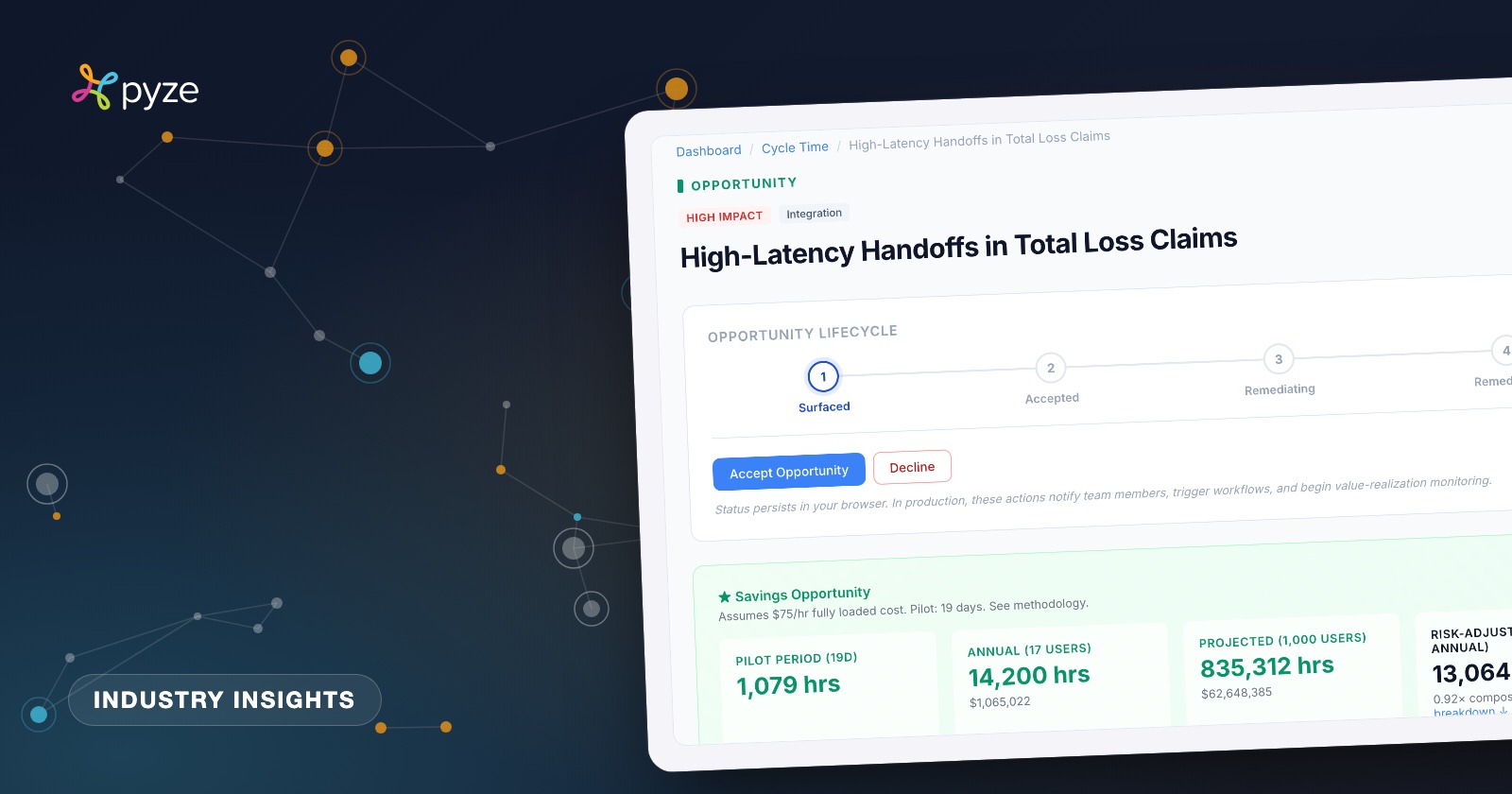
A sample register, sorted by the lever that resolves each opportunity. In an engagement, each line carries measured hours, a named owner and the evidence it was derived from.
Systems typically instrumented
Capture covers browser-delivered and thick-client applications, including virtualized estates, with no change to how anyone works.
Roles Involved
Instrumentation is configured per application rather than per person, so the population in scope is set during scoping and is not a deployment constraint.
How an Engagement Runs
Baseline, blueprint, transform, prove
The same four stages apply in every sector. The fourth stage repeats the baseline measurement, which makes the engagement an ongoing operating capability rather than a one-time report.
Baseline
What the work costs today, measured across every person and application.
Blueprint
Procedures, application rules and execution evidence, read as one target state.
Transform
Where each of the five levers applies, priced and owned.
Prove
The after state measured against the baseline, using the same method.
Frequently Asked Questions
Would a regulator accept this as control evidence?
Industries
Roles
Other functions
Related
Start with a measured baseline
Six weeks from instrumentation to a priced opportunity register, and the baseline stays in place so later quarters are measured rather than re-estimated.