
Questions about what data is collected when work is measured usually come from works councils, privacy officers, employee forums, and HR and Legal leadership. They are often raised after the initial commercial discussions, when those groups review the proposal. Addressing them at the start of an engagement avoids delays later.
This post describes what Pyze collects, what it never collects, and how we suggest discussing it with the people whose work is being measured.
What Is Captured
Pyze captures application interaction metadata: which application, which screen, the sequence of actions and their timing. Specifically:
- Page URLs, limited to an explicitly whitelisted set of business applications
- Navigation and click events
- The timing and order of those actions
- A single user identifier, typically a username or an anonymous ID
The identifier exists so that interaction data can be joined to other datasets for end-to-end analysis. It can be anonymized or pseudonymized at the source, before anything is transmitted, and most deployments run that way. No customer or end-consumer personal data is collected.
What Is Never Captured
| Captured | Never captured |
|---|---|
| Which application and screen | Keystrokes |
| Sequence and timing of actions | Field-level values |
| Navigation and click events | Free-text input |
| A pseudonymous user identifier | Screen contents |
| Whitelisted business applications only | Anything from an application or URL not on the whitelist |
The whitelist takes precedence in every case. If a system has not been explicitly enabled, nothing is captured from it. The data is telemetry and does not include screen recordings. The unit of analysis is the process, not the individual.
Difference From Employee Monitoring
Employee monitoring examines how individuals behave. Execution Intelligence examines how work is performed. The outputs reflect that: processes, volumes, handoffs, where the same work takes different routes, and where effort goes outside the system of record.

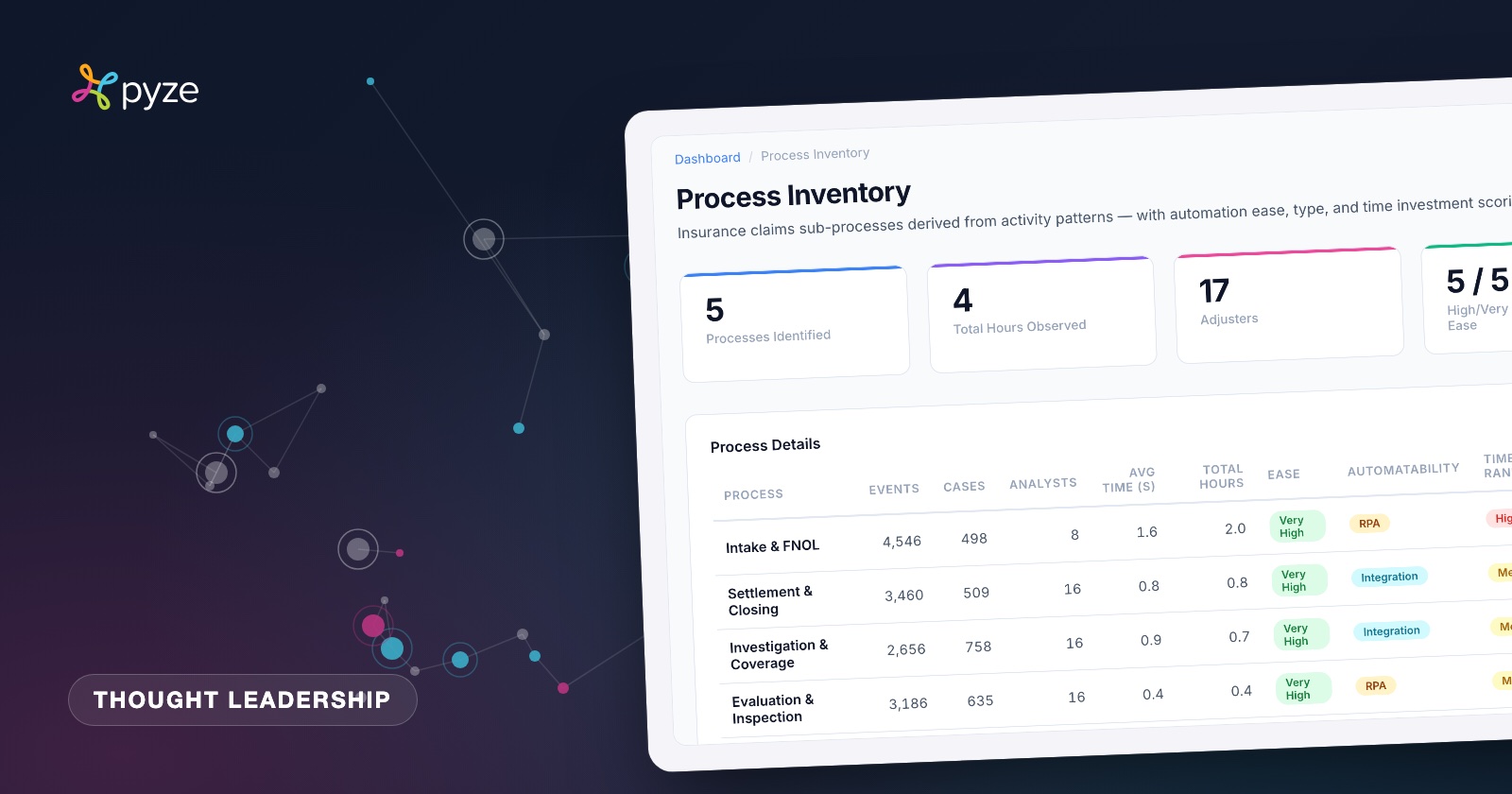
The view above, from the Pyze demo environment, is a list of processes with volumes and automation ease. It is not a list of people. Where a customer wants individual identifiers removed entirely, that is a supported configuration option and not an exception.
Security follows the same approach. Data is encrypted in the browser at the source, in transit and at rest, and the platform can run inside your own cloud environment so that behavioral data does not leave your boundary. Pyze holds SOC 2 Type II and has a current independent penetration test. The details are on the security page.
How to Brief Employees
How the program is communicated affects its outcome as much as the technical design. Deployments that present the measurement as something done with the team, and not to the team, get better data and less resistance. The approach we suggest:
- Have a business sponsor lead. The message should come from someone who owns the process, with HR and Legal in the room.
- State the purpose. The purpose is to improve processes and not to evaluate individuals. Results are reported in aggregate.
- Show the scope. Publish the application whitelist internally before the collector is switched on, so that employees can see what is collected.
- Hold Q&A, then document it. Hold open Q&A in person, follow with a written FAQ, and name a person who can answer follow-up questions.
- Start with a pilot. Run a pilot with a small group before wider rollout.
Works councils and employee forums follow a similar process. The data scope is generally favorable: no keystrokes, no content, no field values, pseudonymizable identifiers and a fixed list of applications. We will join those sessions and answer questions directly rather than leaving the customer to speak on our behalf.
Where to Go Next
- Read the full list of questions in the FAQ, including how this differs from process mining and task mining.
- Review the security and compliance practices and subprocessors.
- See what a first engagement looks like in What an Execution Intelligence Assessment Delivers in Six Weeks.