
Most operations leaders have a dashboard showing how many cases came in, how many closed, and how long the average one took. The figures are accurate, but they describe the start and end of the work and not the work itself.
Handle time is determined between open and close, and the systems that produce the dashboard were not built to record that period.
What Systems of Record Capture
Workflow engines, CRMs and core platforms record state. A case was created. A status changed. A field was written. These are structured events along the standard path, and they show what happened.
That information is necessary but incomplete. It does not show how many minutes someone spent finding the right record, whether they had to leave the system to check something, or how often a case went back for a second pass. A system of record shows the outcome and not the effort.
What Happens Between Systems
The work that goes unlogged falls into a few types.
Swivel-chair moves. A person copies something from one application into another, or checks a third before deciding. Each hop costs time and introduces the risk of error.
Unstructured work. Judgment calls, side spreadsheets and messages to colleagues. This is real effort, and there is no field to record it in.
Rework loops. A case reopens, transfers or escalates, and the cost is spread across several touches that appear unrelated in the logs.
Exceptions. Cases that do not fit the standard path. They are usually worked by hand, outside the workflow, and are often missing from the automation rate reported upward.
A global consumer goods company measured the full working day across applications in its order management operation, rather than only inside the system of record. About 60% of the day sat outside the system of record, and the engagement surfaced 18 priced opportunities. The metrics the system produced were correct, but they covered only the part of the day the system could see.
This affects decisions as well as visibility. If automation candidates are chosen from what the system logs, the largest pool of manual effort is never considered. If staffing is set from handle time alone, a team that loses an hour a day to switching between applications looks the same as one that does not.
Each Platform Holds Part of the Picture
Consider a customer service desk that runs a telephony platform and a case platform side by side. The telephony system records the demand: why the customer called, which queue took the call, and the wait and talk time. The case system records the outcome: that a case exists, how it was classified, and when it closed.
Neither records what the agent did in between, such as searching, switching applications, looking up knowledge base articles or escalating to a colleague. That interval determines handle time and is not measured. We cover this in more detail in Why Contact Center Modernization Needs Measurement Between Telephony and CRM.
This has consequences for modernization. A new platform designed from two systems that each observe half the interaction will inherit the gap between them.

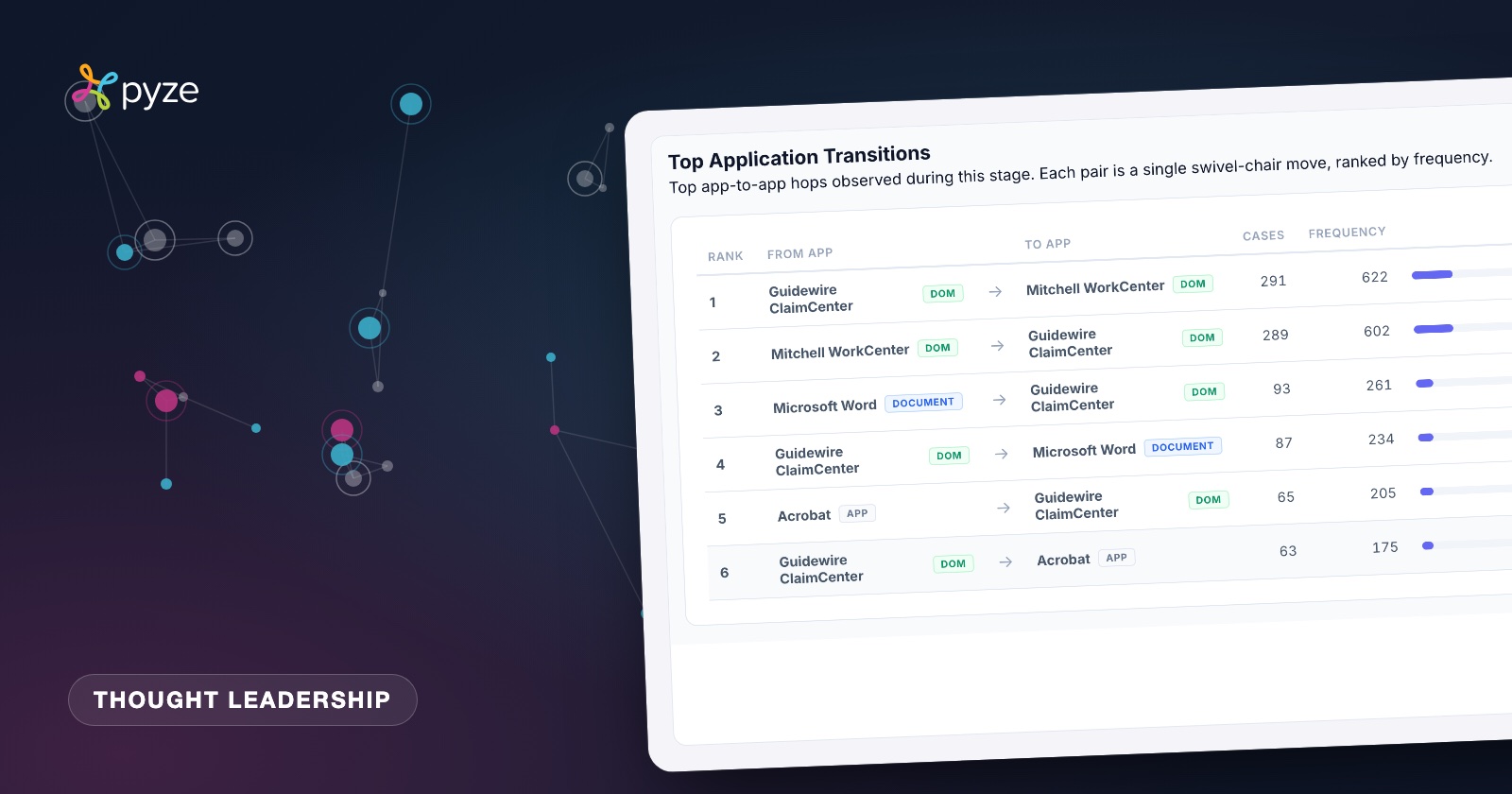
This view, from the Pyze demo environment, ranks application-to-application hops by frequency. Each row is a swivel-chair move. A case system would not produce this list, and it is often the fastest way to identify a first opportunity.
Measuring the Gap Without Monitoring Individuals
Measuring the gap does not require recording what people type or see. Pyze captures interaction metadata: which application, which screen, and the sequence and timing of actions, limited to an explicit whitelist of business applications. It does not capture keystrokes, field values, free text or screen contents. Users are identified by a pseudonymous identifier, and the unit of analysis is the process, not the person.
This is enough to reconstruct the path of the work, count the hops and see where time goes, which is the information needed to decide what to standardize, simplify or automate.
Where to Go Next
- Read the Systems, People, Action page for the three sources of evidence behind the platform.
- See how Productivity Intelligence baselines the work.
- Check the FAQ for exactly what is and is not collected.