
A list of 200 automation ideas does not by itself provide a roadmap. Teams often discover this when they start building the first ten and find that half of them depend on work that should not be happening in that team at all.
The constraint is rarely a shortage of ideas. Once it is possible to see how work is performed, opportunities arrive faster than they can be funded. The harder questions are what to do first and what has to be true before the next initiative makes sense.
Four Programs
Opportunities found in observed work tend to fall into four kinds of change. We treat each as its own program with its own business case.
Rebalance. Pool compatible work and route it by skill, urgency and available capacity, while preserving the controls that matter. Much of what appears to be a staffing shortage is an uneven distribution of work.
Standardize. Run one delivery model across teams and remove the low-value steps. This covers two of the five levers on our methodology page, Standardize and Simplify, because in practice the two are usually done together.
Automate. Execute deterministic work through governed rules and integrations. These are high-frequency, low-variability tasks where the decision is already documented.
Agentify. Deploy governed autonomous agents that prepare or execute decisions, and route ambiguous cases to analysts. This covers judgment-heavy work.
Why the Sequence Matters
Each program lowers the cost of the next, and starting later in the sequence raises it.
Rebalancing comes first because it establishes how much capacity exists and where. Automating a queue that should have been pooled with three other queues means building the same automation several times.
Standardizing comes second. Every variant left in place has to be automated, tested and maintained by someone. Automation should start from a standardized process, not from the accumulated workarounds of four teams doing the same job four different ways.
Automation comes third, applied to the standardized process. The pooling is then re-tested, because that is where the savings from automation are collected. Capacity released in one place has to be redeployed elsewhere, or it is absorbed into the average.
Agents come last, applied to the judgment-heavy cases that remain. By then the standard is defined, which is necessary because an agent needs a reference to be measured against, and a person who overrides it needs a standard to point to.
Evidence for Each Program
Each program needs different evidence. Rebalancing needs workload and capacity by team. Standardization needs the variants. Automation needs the repeatable sequences. Agents need the judgment-heavy tasks and the exceptions.
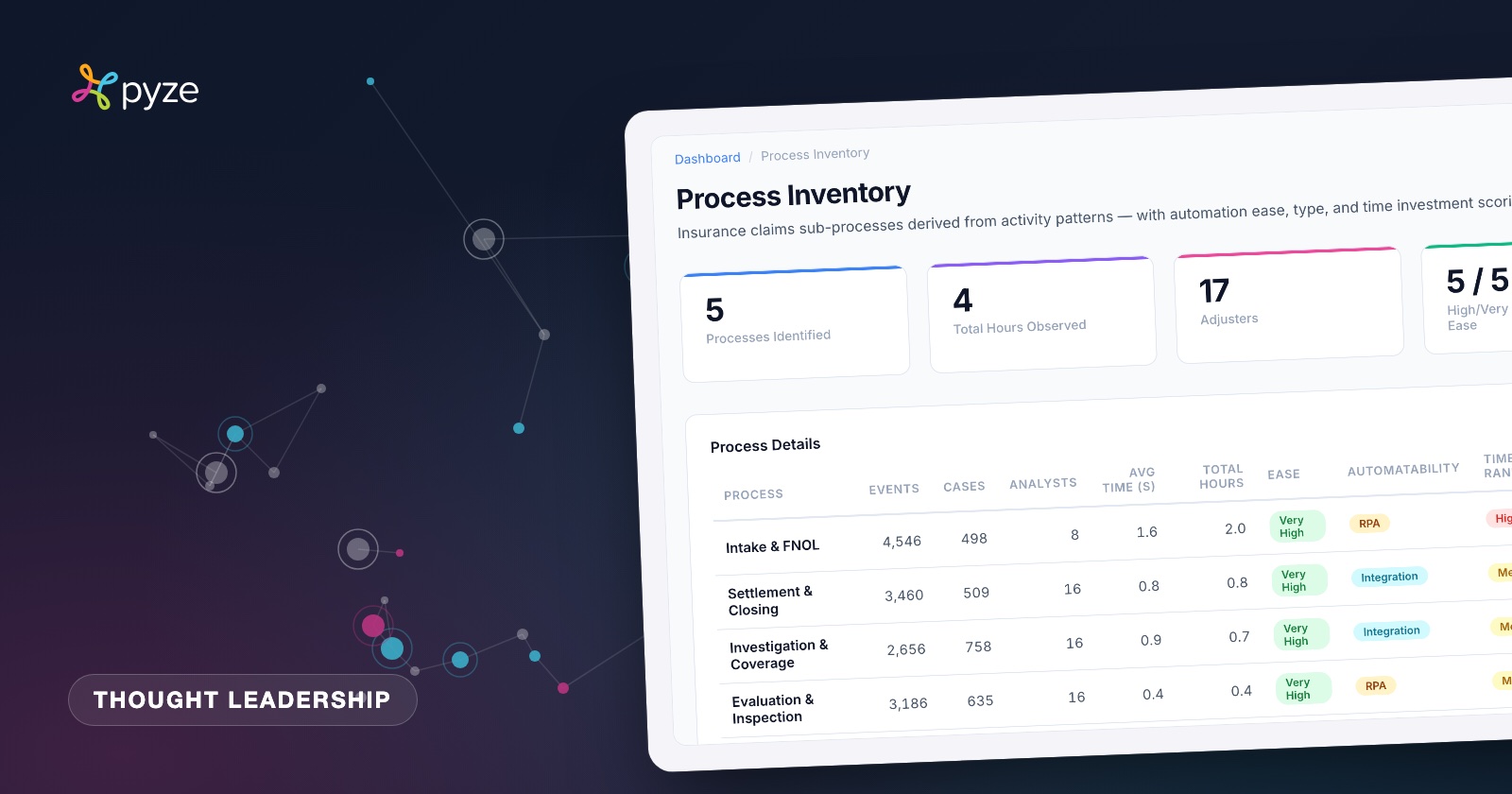
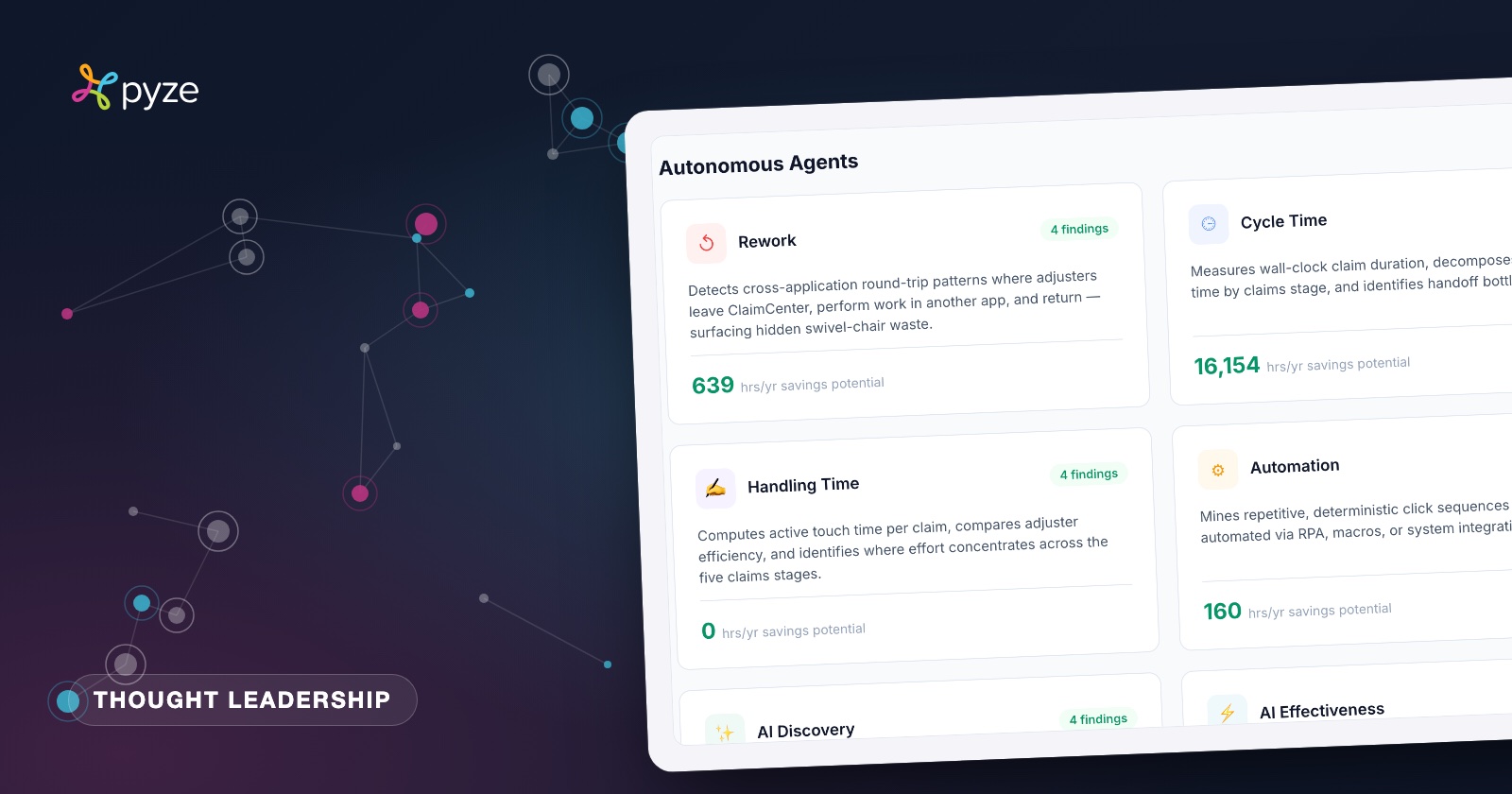
In the Pyze demo environment, separate agents look at rework, cycle time, handling time, automation candidates, AI augmentation and AI effectiveness, each reporting its own findings with the supporting evidence.

Evidence from outside the system of record is especially important. In a global consumer goods order management operation, about 60% of the working day sat outside the systems the team reported against, and 18 priced opportunities came out of that gap. None of them would have appeared in a workflow report, because none of that work reached a workflow.
Sizing Value Before Deploying Technology
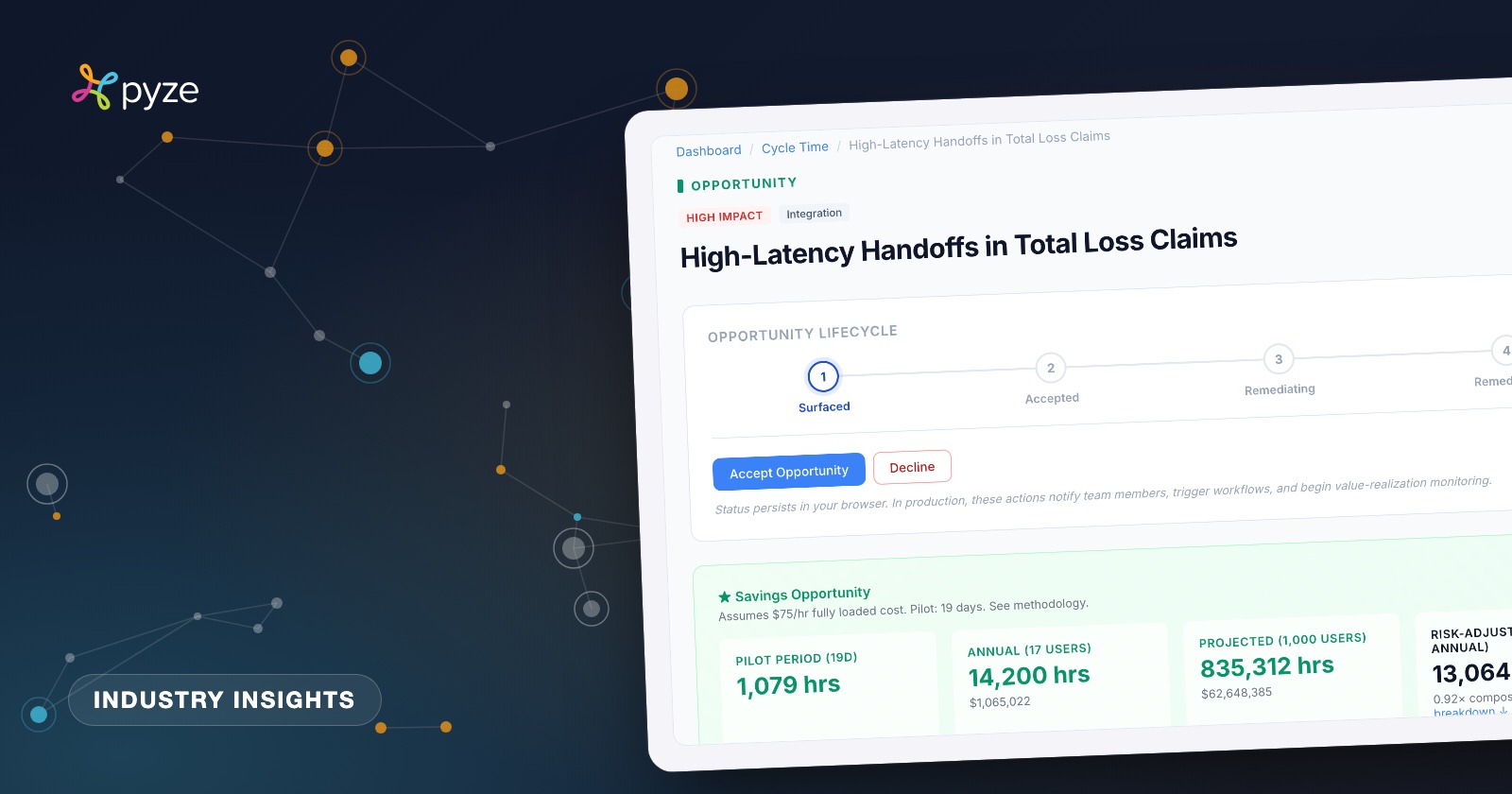
Every opportunity is sized from observed work and assigned to a program, so the business case for each exists within weeks, before any technology is deployed. This allows teams to choose what to build based on evidence, rather than buying a platform first and looking for use cases afterward.
Pyze does not build or run the agents. It identifies where they belong, sizes the opportunity, and measures what changed once they were in place. Because the same measurement that justified the work is used to check whether it paid back, the assessment remains independent of the build.
The recommended sequence is to pool, standardize, automate, then agentify. Teams that reverse it often spend a year automating a process that they later have to redesign.
Where to Go Next
- Read how the evidence layer is built in Systems, People, Action.
- See how we score which work suits automation and which suits augmentation in Scoring Work for Automation, Augmentation or Neither.
- Look at the Autonomous Agents product, or schedule a demo and we will walk through it on a workflow of yours.